
Join The Link Letter community
Learn the systems and strategies behind modern link building and authority-first SEO.
Join SEOs, marketers & founders learning modern authority building
Join SEOs, marketers & founders learning modern authority building

2025 affords SEOs an abundance of challenges to keep up with the industry’s ever-changing landscape. But as we all know, with great challenges come great opportunities.
Planning and designing a well-constructed link building campaign can put you ahead of your competitors and help you rank higher in SERPs.
A solid campaign will help you build relationships, increase brand awareness, and drive traffic to your website.
Today, we’ll show you how to build a solid link building campaign in 8 steps. We’ll also provide some actionable tips that you can implement immediately.
But first, let’s answer a crucial question.
Strategy this, plan that, campaign the other thing.
What does this all mean?
More importantly, where does link building fit into the grand scheme of things?
A link building campaign is a deliberate, organized effort to increase the number and quality of inbound links. This is slightly different from a plan or strategy; both are broader in scope.
In a campaign, you have specific objectives and goals that you want to achieve. You also have a set timeframe in which you want to achieve these goals.
Plans and strategies, on the other hand, are more flexible. You can constantly adjust your plans and strategies as you see fit. But with a campaign, you want to stick to the original plan as much as possible.
Of course, there will be times when you need to make adjustments to your campaign. But for the most part, you want to stick to the plan.
Besides, the whole point of a campaign is to have a focused effort. Trying to do too many things at once will only dilute your efforts and results.
Link building is by its very nature, a creative, and fluid craft.
What works for one website and niche, may not work for another.
Because of this, it’s really important that you design your link building campaigns, knowing the nuances of your website, the niche, who you’re targeting, the competitors you’re up against, and the kind of links (and audience you’re trying to attract.)
If you can crack this, it means:
Every campaign represents a fresh new problem. To solve that problem, you need a unique equation. Providing you with a fixed, foolproof process would be shortsighted.
Instead, we’ll walk you through a flexible methodology you can adjust according to the specific needs of your campaign.

This might sound like a no-brainer, but you’d be surprised how many people start their campaigns without a clear goal.
Your goal should answer the question: what does success look like?
In other words, what do you want to achieve with your link building campaign? Do you want to increase brand awareness? Drive traffic to your website? Or improve your search engine rankings?
You can have multiple goals for your campaign. But, as we said before, trying to do too many things at once will only dilute your efforts.
That’s why it’s essential to have a primary goal that you want to focus on. The other goals should be secondary and should support your primary goal.
When setting goals, remember to:
The next step is to conduct a link audit. This will give you a clear picture of your current link profile and help you identify potential issues or problems.
A link audit will also help you understand where you currently stand regarding link building. You can develop a more informed link-building strategy by analyzing your competitors’ link profiles and backlink strategies.
Platforms like Ahrefs and SEMrush provide “link gap analysis” features that allow you to compare your link profile with that of your competitors. This is an invaluable tool for conducting a link audit.
When conducting a link audit, be sure to:

Performing a basic audit will set the tone for the rest of your campaign and help you identify any potential problems.
Just a big caveat on toxic links:
Don’t follow Semrush’s toxic link report blindly.
It just seems overly paranoid and flags links that probably are not toxic. Instead, use the report as a starting point for conducting your own link audit.
Using your judgment will help you find more actionable information.
Now that you have a clear goal and a good understanding of your link profile, it’s time to start developing your link building strategy.
There are a few key things you need to consider when developing your strategy:
Once you’ve considered all these factors, you’ll be in an excellent position to develop your link-building strategy.
For example, let’s assume your situation looks like this:
With these factors in mind, you might focus on developing relationships with other websites in your industry and guest posting on relevant blogs.
You could also consider conducting a content marketing campaign to promote your guides and attract natural backlinks, as well.
The idea is to focus your efforts on activities most likely to help you achieve your goal and that play to your strengths.
Tactics play a vital role in link building. You’ll pursue these specific activities as part of your campaign.
You can pursue a wide range of link-building tactics, and the best tactics for your campaign will depend on your situation.
Some popular link building strategies include:
Your chosen tactics should align with your goals, budget, resources, and timeline.
For example, if you’re on a tight budget and need results quickly, you might want to focus on tactics like guest blogging and resource page link building.
These activities are relatively cheap, and they can generate results reasonably quickly.
If you have a large budget and are not worried about immediate results, you might want to focus on PR.
These activities can be more expensive, but they can also generate high-quality links that will significantly impact your campaign.
Also, analyze your existing collateral to see what can be used to generate links.
Your most effective technique will depend on your existing resources.
For example, if you’re a startup with a newsworthy backstory, you might want to leverage that to get PR coverage.
If, on the other hand, you have proprietary research universities tend to like, you might want to focus on universities and other research institutions.
In other words, focus on what you have, and then find ways to leverage it.
Once you’ve selected your tactics, it’s time to start putting together your link building plan.
Your link building plan should include:
Your plan should be as specific as possible. For example, if you’re going to guest blog, you should have a list of target websites and a schedule for when you will reach out to them.
You also need a list of the tools and resources to execute each tactic.
This could include a list of relevant outreach platforms or a copywriting guide.
Your plan should be flexible enough to accommodate the budget, timeline, or resource changes. But it should also be specific enough to give you a clear roadmap for your campaign.
Before you start your link building campaign, you need to set success parameters.
You’ll use these metrics to track your progress and determine whether your campaign is successful.
Some standard success parameters include:
Of course, this isn’t a comprehensive list of all the possible success parameters for a link building campaign. You’ll need to decide which metrics are most important for your business.
Also, consider that not all companies/industries require high-authority links.
You see, most SEOs tend to use “low-authority” and “low-quality” interchangeably. But not all low-authority links are bad, and not all high-authority links are good.
The value of a link depends on your industry, the quality of your content (or website), and what you’re hoping to achieve with a link building campaign.
For example, a pretty active blogger with a few thousand visitors per month and a good amount of social media engagement might be considered a “low-authority” site.
But, does that mean that site is low-quality?
Of course not.
The same goes for a high-authority site.
The most authoritative and reputable sites on the internet are not always the best places to build links from. They might not have much content that matches your industry, or their audience may not be interested in what you’re offering.
Ultimately, you need to do your research and find sites that are a good fit for your brand.
Now it’s time to start executing your link building campaign.
This is where all your planning will come together.
Start by executing the tactics you’ve laid out in your plan. Be sure to track your progress using the success parameters you’ve defined.
As you’re executing your campaign, you might need to adjust your plan. This is normal. Please document any changes you make to track your progress more accurately.
You’ll need to monitor and adjust your tactics as your campaign progresses.
This is an essential part of any link building campaign. By monitoring your progress, you can ensure you’re on track to meet your goals.
Don’t be afraid to adjust your tactics if you do not see the desired results. Try different approaches and see what works best for your campaign.
Here’s a practical process you can use:
Step 1: Sort your target lists into batches according to the sector/type of pages you’re reaching out to.
For instance you might want to break them down into small to medium business, editorials and blogs.
Step 2: Set a daily/weekly/monthly goal for each batch of links you’re building. This will help keep you on track as you monitor your progress over time.
Step 3: See what gets the best reply rates/win rate.
Split test your subject lines, see what works best within that batch, and use that as a guide for future outreach.
If a particular content piece, or batch of targets does really well and gets a good win rate, ask yourself:
If the answer to any of these questions is yes, then by all means: do more research and try again! If not, then it’s time to move on.
You can always just keep an eye on this batch of outreach results and try again in a few months if you want.
At TLG, we are constantly monitoring the results in real-time, and leverage the power of data, to understand what is working, and where we should focus our efforts.
Tools like Pitchbox have reports built in which can help, but we always advise to gather your own data, and slice up the data in your own way, to gain deeper insights.
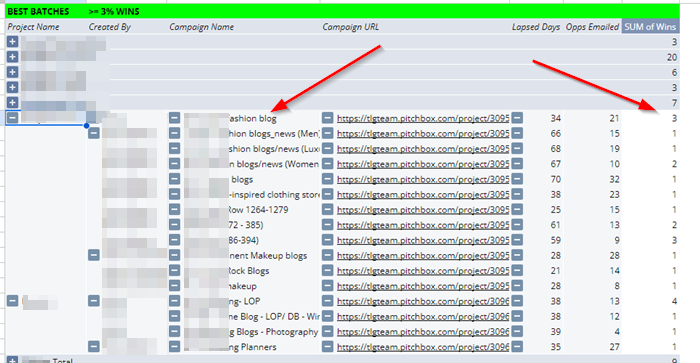
The most important thing is to keep testing and tweaking until you find a winning formula. Then, you can scale up your campaign and start seeing the desired results.
While there’s so many ways a campaign can go, one of the fastest ways to get started, is to start with a data-driven approach. And then have a solid, systematized process which can turn it into links.
Firstly, looking at your own backlink profile and trying to determine what has already been working and perhaps learning from any natural/earned links that you already have.
But combining this with insights from competitor backlink analysis – both domain-level competitors, and page-level SERP competitors. Tools like Ahrefs and Semrush, will be instrumental here, as it allows you to quickly filter through these backlink profiles at a much faster rate – and then build out your first campaigns, based on those findings.
Here’s an example of us going through a site and quickly finding a couple of addiction resource page opportunities – which we could turn into a larger campaign for our own project.

Next, is data prospecting. While you can scrape lists in bulk, you really need to have a prospecting team in place who can vet the lists, and do manual prospecting tasks as well. They can take those seed ideas and turn them into clean prospecting lists. What you should end up with, is batches of URLs that are aligned with your link building campaign idea, along with contact information.
Outreach comes after this. This is notoriously time-consuming – but using an outreach platform like Pitchbox or Mailshake, will help automate some parts of the process – but allow the outreacher to personalize parts of the email as well.

Make sure to conduct follow ups, and stay on top of leads – and you’ll have links faster than you can say “link building campaign”!
Now that you know all the steps to take when designing a link building campaign, it’s time to get started!
Remember to focus on quality over quantity and to be patient — link building is a long-term strategy. But if you stick with it, your hard work will pay off.
And if you need someone to do all the heavy lifting for you – contact our team at The Links Guy, and we’ll help you plan, build and execute link building campaigns, and iterate the process, until they do work successfully.

I’m a marketer, entrepreneur, SEO consultant & link building agency owner based in Scotland, United Kingdom. I'm also the founder and MD of TheLinksGuy



